

- Market Size (2026)
- USD 317.92 Mn
- Forecast (2036)
- USD 877.74 Mn
- CAGR (2026 to 2036)
- 4.6%
Volleyball Shoes Market Size, Market Forecast and Outlook By FMI
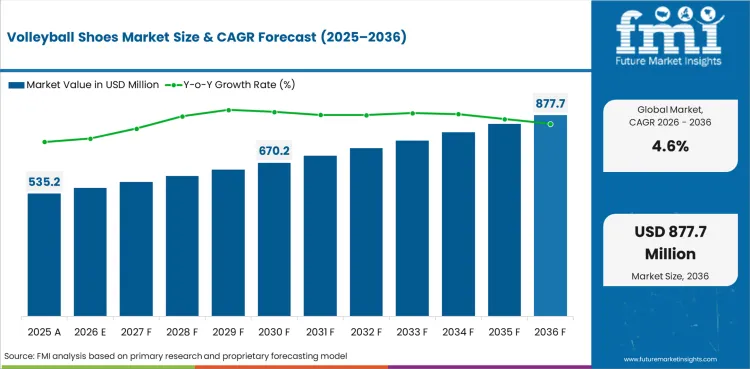
The volleyball shoes market is expected to expand from USD 559.82 million in 2026 to USD 877.74 million by 2036. The market is anticipated to register a 4.6% CAGR during the forecast period as sport participation creates consistent replacement demand. All-rounder volleyball shoes are likely to lead with 44.6% share, and sports applications are projected to account for 52.3% share in 2026.
Summary of the Volleyball Shoes Market
- Demand and Growth Drivers
- Rising volleyball participation is expected to lift demand for shoes designed for indoor traction and lateral stability.
- School teams and club programs are likely to increase repeat purchases across mid-priced performance footwear.
- Court movement needs are anticipated to push players toward cushioning systems and non-marking sole designs.
- Product and Segment View
- All-rounder volleyball shoes are expected to lead the shoe type segment with 44.6% share in 2026.
- Sports applications are likely to represent 52.3% share as active play serves as the main purchase trigger.
- Men are anticipated to capture 58.7% of consumer orientation share in 2026 across organized participation channels.
- Geography and Competitive Outlook
- The USA is expected to lead country-level expansion at a 4.7% CAGR through 2036 across school and club volleyball.
- The EU and Japan are likely to record 4.6% CAGR through 2036 across established volleyball cultures.
- ASICS Corporation is anticipated to retain a strong position through volleyball-specific design and athlete endorsement programs.
- Analyst Opinion
- According to Ronak Shah, Principal Consultant for Consumer Product at FMI: “Volleyball shoes are expected to gain stronger buyer attention as players seek better grip and cushioning for fast court movement. Brands with credible sports testing and affordable product ladders are likely to gain stronger access across recreational and competitive buyer groups.”
- Volleyball Shoes Market Value Analysis
- The volleyball shoes market is moving from general indoor athletic footwear into a court-specific performance segment.
- Demand is likely to rise as players choose footwear built for grip and impact absorption.
- Adoption is expected to gain pace through online retail and specialty sporting goods stores during the forecast period.
- Spending is anticipated to improve as school programs and recreational leagues extend the replacement base.
Key Takeaways, Market Size, and Forecast
| Metric | Value |
|---|---|
| Market Size (2026) | USD 559.82 Million |
| Market Size (2036) | USD 877.74 Million |
| CAGR (2026–2036) | 4.6% |
| Incremental Opportunity (2026–2036) | USD 317.92 Million |
| Leading Shoe Type (2026) | All-Rounder Volleyball Shoes |
| All-Rounder Volleyball Shoes Share (2026) | 44.6% |
| Leading Application (2026) | Sports Applications |
| Sports Applications Share (2026) | 52.3% |
| Leading Consumer Orientation (2026) | Men |
| Men Share (2026) | 58.7% |
| Fastest-Growing Country | USA |
| USA CAGR | 4.7% |
Volleyball Shoes Market Definition
The Volleyball Shoes Market encompasses footwear specifically designed for volleyball play, including court shoes engineered for traction, impact absorption, lateral stability, and ankle support. The market covers shoes for competitive, recreational, and lifestyle use, sold through online and offline channels.
Volleyball Shoes Market Inclusions
Market scope includes all commercially traded volleyball shoes categorized by type (all-rounder, defense position, attack position), application (sports, lifestyle, competition), consumer orientation (men, women, kids), and outer material (synthetic, mesh, laminates, leather, others). The revenue range spans 2026 to 2036.
Volleyball Shoes Market Exclusions
The scope does not include general athletic shoes, running shoes, basketball shoes, or indoor court shoes not specifically designed or marketed for volleyball play.
Volleyball Shoes Market Research Methodology
- Primary Research: FMI analysts conducted interviews with footwear manufacturers, sporting goods retailers, and volleyball federation representatives across key markets.
- Desk Research: Combined sporting goods industry data, volleyball participation statistics, and retail sales information from major markets.
- Market Sizing and Forecasting: Bottom-up aggregation across shoe type segments and regional participation curves, validated through top-down cross-referencing.
- Data Validation: Cross-checked quarterly against sporting goods retail data and manufacturer-reported sales figures.
Why is the Volleyball Shoes Market Growing?
- Volleyball participation is expanding at both recreational and competitive levels across North America, Europe, and East Asia, creating consistent demand for sport-specific footwear.
- Performance differentiation in footwear technology, including cushioning systems, court grip patterns, and lightweight materials, is increasing the willingness of players to purchase dedicated volleyball shoes.
- The USA (4.7%) leads growth as high school, collegiate, and recreational volleyball participation continues to expand.
Demand for volleyball shoes reflects growing global participation in the sport across institutional, recreational, and competitive channels. Volleyball federations in Europe, East Asia, and the Americas report steady membership growth, creating a broadening base of active players who require sport-specific footwear. This participation growth translates into consistent demand for shoes that deliver court-appropriate traction, cushioning, and lateral stability.
All-rounder volleyball shoes (44.6% of type share) dominate the market because most recreational and amateur players prefer a single versatile shoe rather than position-specific options. This segment benefits from broader appeal and higher purchase frequency compared to specialized attack or defense shoes, which are primarily purchased by competitive-level players.
Material technology is a competitive differentiator. Synthetic materials (36.9% share) offer cost-effective durability and design flexibility, while mesh constructions provide improved breathability and lighter weight for performance-focused buyers. Brands investing in proprietary cushioning and traction technologies are capturing price premiums at the competitive tier.
Market Segmentation Analysis
- All-rounder volleyball shoes hold 44.6% of the shoe type segment, reflecting broad versatility across playing positions and skill levels.
- Sports applications account for 52.3% of demand, confirming competitive and recreational play as the primary purchase driver.
- Men represent 58.7% of consumer orientation share, reflecting higher male participation rates in organized volleyball programs.
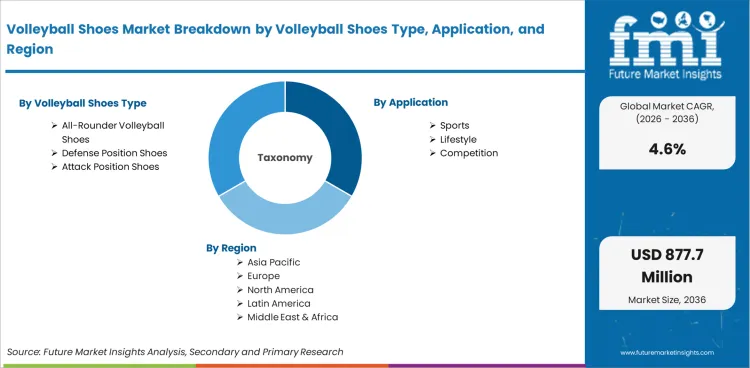
The Volleyball Shoes Market is segmented by shoe type (all-rounder, defense position, attack position), application (sports, lifestyle, competition), consumer orientation (men, women, kids), and outer material (synthetic, mesh, laminates, leather, others).
Insights into the All-Rounder Volleyball Shoes Segment
In 2026, all-rounder volleyball shoes are expected to represent 44.6% of the shoe type segment. These shoes serve recreational players, amateur competitors, and school-level athletes who need a single pair for all court positions.
Demand is shaped by the preference for versatile design that combines adequate cushioning, traction, and ankle support without position-specific optimization. This segment captures the highest volume of purchases.
Insights into the Sports Application
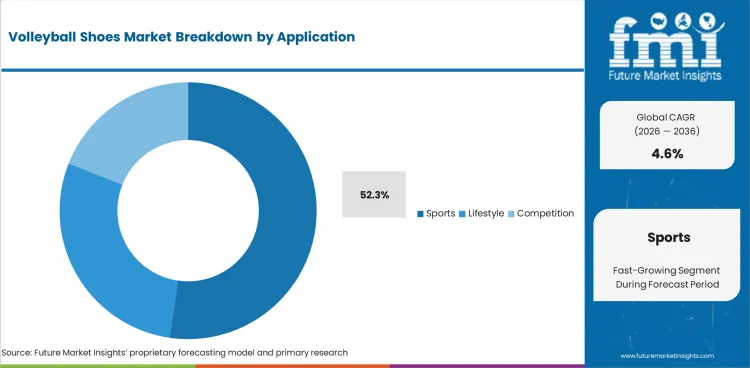
Sports applications account for 52.3% of demand. Competitive and recreational volleyball players require footwear that meets specific performance criteria including non-marking soles, gum rubber traction patterns, and impact-absorbing midsole technology.
Growth in this segment is supported by increasing volleyball league membership and expanding school and university-level programs across North America and Europe.
Volleyball Shoes Market Drivers, Restraints, and Opportunities
- Growing volleyball participation at recreational and competitive levels is creating sustained demand for sport-specific footwear across key markets.
- Competition from general indoor court shoes constrains market expansion, as price-sensitive buyers may substitute volleyball-specific shoes with multi-sport alternatives.
- Lifestyle crossover demand offers expansion opportunities as volleyball-inspired designs gain traction in casual footwear segments.
The Volleyball Shoes Market benefits from growing volleyball participation and performance footwear differentiation. Multi-sport shoe competition and price sensitivity present constraints, while lifestyle crossover and emerging market penetration offer growth opportunities.
Volleyball Participation Growth
Demand is shaped by increasing volleyball participation across school, recreational, and competitive channels. Federation membership growth, expansion of youth programs, and rising media visibility of professional volleyball are broadening the consumer base for sport-specific footwear.
Multi-Sport Shoe Competition
Growth is constrained by competition from general indoor court shoes. Recreational players with limited budgets may choose multi-sport shoes over volleyball-specific options, particularly at lower skill levels where performance differentiation is less apparent.
Performance Technology Differentiation
Adoption is increasing due to advances in cushioning, traction, and stability technologies that are specific to volleyball movement patterns. Brands investing in biomechanical research and athlete-endorsed designs are capturing price premiums.
Lifestyle and Casual Crossover
Growth reflects emerging consumer interest in volleyball-inspired casual footwear. Design aesthetics from performance volleyball shoes are being adapted for lifestyle use, creating new purchase occasions and expanding addressable demand.
Analysis of Volleyball Shoes Market By Key Countries
.webp "Top Country Growth Comparison Volleyball Shoes Market Cagr (2026 2036)")
| Country | CAGR |
|---|---|
| USA | 4.7% |
| UK | 4.5% |
| EU | 4.6% |
| Japan | 4.6% |
| South Korea | 4.6% |
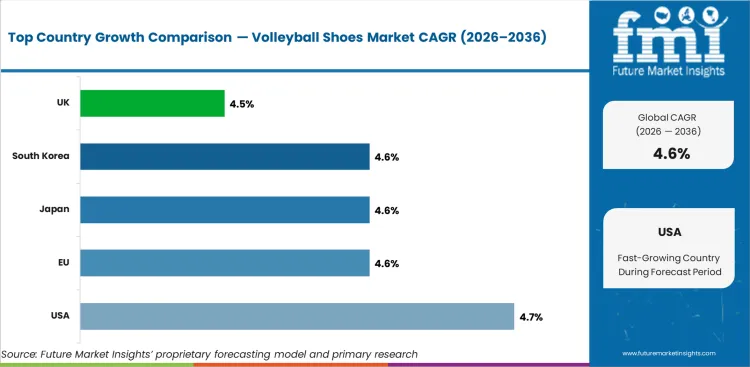
- The USA leads growth at 4.7% CAGR, reflecting strong volleyball participation across high school, collegiate, and recreational levels.
- The EU and Japan (both 4.6%) sustain demand through established volleyball cultures and competitive league structures.
- South Korea (4.6%) and the UK (4.5%) support growth through expanding participation programs and retail infrastructure.
The global Volleyball Shoes Market is expected to expand at a CAGR of 4.6% from 2026 to 2036. The analysis covers key markets including the USA, UK, EU, Japan, and South Korea.
Demand Outlook for Volleyball Shoes Market in USA
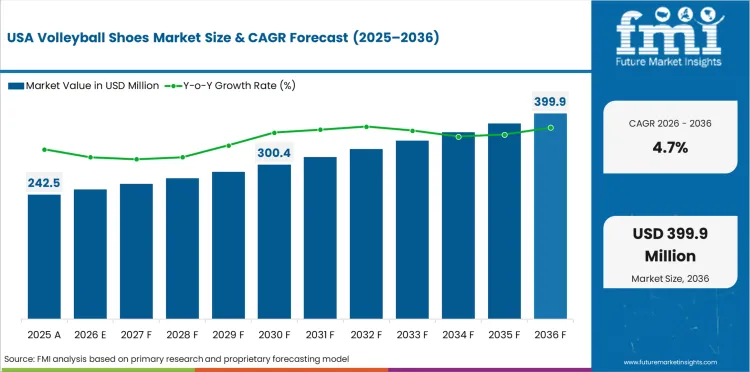
The USA is expected to lead growth at 4.7% through 2036, supported by strong volleyball participation across high school, collegiate, and recreational levels, along with established sporting goods retail infrastructure.
- High school and collegiate volleyball programs sustain equipment demand.
- Recreational league growth broadens the consumer base.
- Retail infrastructure supports wide product availability.
Future Outlook for Volleyball Shoes Market in UK
The UK is expected to grow at 4.5% through 2036, reflecting growing volleyball participation and increasing availability of sport-specific footwear through online and physical retail channels.
- Volleyball participation growth supports sport-specific shoe demand.
- Online retail improves product accessibility and brand discovery.
- League development programs expand the player base.
Opportunity Analysis of Volleyball Shoes Market in EU
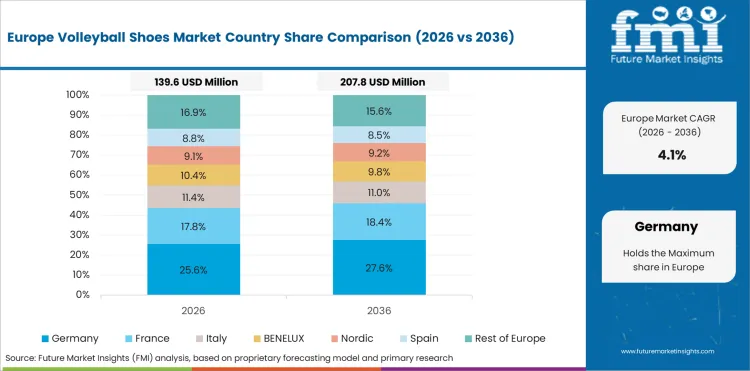
The EU is expected to grow at 4.6% through 2036, driven by established volleyball traditions in Italy, Poland, and France, combined with strong professional league visibility.
- Established volleyball traditions sustain competitive footwear demand.
- Professional league visibility supports brand engagement.
- Multi-country distribution networks enable broad market access.
In-depth Analysis of Volleyball Shoes Market in Japan
Japan is expected to grow at 4.6% through 2036, reflecting deep volleyball culture, strong domestic manufacturer presence, and high consumer demand for performance-engineered footwear.
- Deep volleyball culture sustains consistent footwear demand.
- Domestic manufacturers (ASICS, Mizuno) drive product development.
- Performance-conscious consumers support premium pricing.
Sales Analysis of Volleyball Shoes Market in South Korea
South Korea is expected to grow at 4.6% through 2036, supported by active volleyball participation, professional league engagement, and demand for performance footwear.
- Professional league engagement drives brand awareness.
- Active participation culture supports equipment demand.
- Digital commerce supports rapid product cycle adoption.
Competitive Landscape and Strategic Positioning
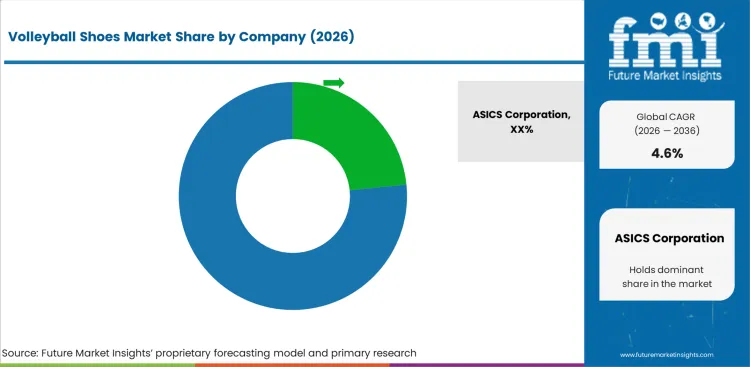
- ASICS Corporation leads with an estimated 23.4% market share, leveraging volleyball-specific expertise and professional athlete endorsements.
- Mizuno Corporation and Nike, Inc. hold strong positions through broad athletic footwear portfolios that include dedicated volleyball product lines.
- Emerging Asian brands including Li-Ning and PEAK are expanding into international markets through competitive pricing strategies.
ASICS Corporation maintains market leadership through its long-established focus on volleyball footwear, with product lines that include position-specific and all-rounder options backed by biomechanical research. The company's professional athlete endorsement program supports brand credibility in the competitive segment.
Mizuno Corporation competes through performance-engineered volleyball shoes that emphasize cushioning technology and court feel. The company's strong presence in Japan and growing international distribution support its market position.
Nike, Inc. and Adidas AG leverage broad athletic footwear portfolios to serve the volleyball market, benefiting from brand recognition and multi-channel distribution while offering volleyball-specific designs within larger product ecosystems.
Emerging competition from Asian brands including Li-Ning, PEAK Sport Products, and ERKE is increasing in price-sensitive markets, where competitive pricing and expanding distribution challenge established premium brands.
Key Companies in the Volleyball Shoes Market
Key global companies leading the volleyball shoes market include:
- ASICS Corporation (Japan), Mizuno Corporation (Japan), Nike, Inc. (USA), and Adidas AG (Germany) maintain dominant positions through performance technology, brand equity, and global distribution.
- Under Armour, Inc. (USA), Decathlon (France), and Yonex Co., Ltd. (Japan) hold regional positions through targeted volleyball product lines and specialized retail channels.
- ERKE (China), PEAK Sport Products (China), Li-Ning (China), and Babolat VS (France) represent emerging competition through competitive pricing and expanding international distribution.
Competitive Benchmarking: Volleyball Shoes Market
| Company | Brand Equity | Product Range | Distribution Reach | Performance Technology |
|---|---|---|---|---|
| ASICS Corporation | High | Broad | Global | High |
| Mizuno Corporation | High | Moderate | Global | High |
| Nike, Inc. | High | Broad | Global | Moderate |
| Adidas AG | High | Moderate | Global | Moderate |
| Under Armour, Inc. | Moderate | Narrow | N. America | Moderate |
| Decathlon (Kipsta) | Moderate | Moderate | Global | Low |
| Yonex Co., Ltd. | Moderate | Narrow | Asia | Moderate |
| Babolat VS | Low | Narrow | Europe | Moderate |
| PEAK Sport Products | Low | Moderate | Asia | Low |
| Li-Ning Company | Moderate | Moderate | Asia | Moderate |
Source: Future Market Insights competitive analysis, 2026.
Key Developments in Volleyball Shoes Market
- In 2025, ASICS Corporation launched a next-generation volleyball shoe featuring updated gel cushioning and enhanced court grip for competitive players.
- In 2025, Mizuno Corporation introduced a lightweight volleyball shoe with reactive midsole technology targeting attack-position players.
Key Players in the Volleyball Shoes Market
Major Global Players
- ASICS Corporation
- Mizuno Corporation
- Nike, Inc.
- Adidas AG
- Under Armour, Inc.
- Decathlon (Kipsta brand)
- Yonex Co., Ltd.
Emerging Players/Startups
- Babolat VS
- ERKE (HongXing Erke Group)
- PEAK Sport Products Co.
- Li-Ning Company Limited
- Tachikara USA
- 361 Degrees International
- Anta Sports
- Lotto Sport Italia
Report Scope and Coverage
| Parameter | Details |
|---|---|
| Quantitative Units | USD 559.82 million to USD 877.74 million, at a CAGR of 4.6% |
| Market Definition | The volleyball shoes market encompasses footwear designed for volleyball play, including court shoes for traction, impact absorption, and lateral stability. |
| Regions Covered | North America, Latin America, Europe, East Asia, South Asia and Pacific, Middle East and Africa |
| Countries Covered | USA, UK, EU, Japan, South Korea, 30 plus countries |
| Key Companies Profiled | ASICS Corporation, Mizuno Corporation, Nike, Inc., Adidas AG, Under Armour, Inc., Decathlon, Yonex Co., Ltd., PEAK Sport Products, Li-Ning |
| Forecast Period | 2026 to 2036 |
| Approach | Hybrid bottom-up and top-down methodology starting with verified retail transaction data, projecting adoption velocity across segments and regions. |
Market Segmentation Analysis
Volleyball Shoes Market Segmented by Volleyball Shoes Type:
- All-Rounder Volleyball Shoes
- Defense Position Shoes
- Attack Position Shoes
Volleyball Shoes Market Segmented by Application:
- Sports
- Lifestyle
- Competition
Volleyball Shoes Market Segmented by Consumer Orientation:
- Men
- Women
- Kids
Volleyball Shoes Market Segmented by Outer Material:
- Synthetic
- Mesh
- Laminates
- Leather
- Others
Volleyball Shoes Market Segmented by Sole Type:
- Rubber
- EVA
- PU
- PVC
- Others
Volleyball Shoes Market Segmented by Sales Channel:
- Online Retailers
- Multi-brand Stores
- Independent Small Stores
- Other Sales Channel
Volleyball Shoes Market by Region:
- North America
- USA
- Canada
- Mexico
- Latin America
- Brazil
- Chile
- Rest of Latin America
- Western Europe
- Germany
- UK
- Italy
- Spain
- France
- Nordic
- BENELUX
- Rest of Western Europe
- Eastern Europe
- Russia
- Poland
- Hungary
- Balkan & Baltic
- Rest of Eastern Europe
- East Asia
- China
- Japan
- South Korea
- South Asia and Pacific
- India
- ASEAN
- Australia & New Zealand
- Rest of South Asia and Pacific
- Middle East & Africa
- Kingdom of Saudi Arabia
- Other GCC Countries
- Turkiye
- South Africa
- Other African Union
- Rest of Middle East & Africa
Research Sources and Bibliography
- 1. International Volleyball Federation (FIVB). (2025). FIVB Global Volleyball Participation Report. FIVB.
- 2. Outdoor Industry Association. (2025). Sports Participation and Equipment Trends. OIA.
- 3. USA Bureau of Labor Statistics. (2025). Consumer Expenditure Survey: Footwear Category. BLS.
- 4. European Commission. (2024). EU Sports Industry Economic Report. EC.
- 5. World Federation of Sporting Goods Industry. (2025). WFSGI Market Data Report. WFSGI.
This bibliography is provided for reader reference.
This Report Answers
- Estimating the size of the market and revenue projections from 2026 to 2036.
- Segmentation by shoe type, application, consumer orientation, and outer material.
- Regional and country-level demand analysis across key markets.
- Competitive landscape assessment and company benchmarking.
- Analysis of performance technology trends in volleyball footwear.
- Distribution channel dynamics and e-commerce penetration.
- Identification of growth opportunities in lifestyle crossover and emerging markets.
Frequently Asked Questions
What is the global market size for Volleyball Shoes in 2026?
In 2026, the global Volleyball Shoes Market is expected to be valued at USD 559.82 million.
How large will the Volleyball Shoes Market be in 2036?
By 2036, the Volleyball Shoes Market is expected to reach USD 877.74 million.
What is the projected CAGR for the Volleyball Shoes Market from 2026 to 2036?
The Volleyball Shoes Market is projected to expand at a CAGR of 4.6% from 2026 to 2036.
Which shoe type is expected to lead in 2026?
All-rounder volleyball shoes are expected to account for 44.6% of the shoe type segment in 2026, reflecting their versatility across playing positions and skill levels.
What is driving demand in the USA?
The USA is expected to grow at 4.7% through 2036, driven by strong volleyball participation across high school, collegiate, and recreational levels.
What is driving demand in the EU?
The EU is expected to grow at 4.6% through 2036, supported by established volleyball traditions, professional league visibility, and multi-country distribution networks.
What does this report mean by 'Volleyball Shoes Market'?
The Volleyball Shoes Market includes footwear specifically designed for volleyball play, covering court shoes for traction, impact absorption, lateral stability, and ankle support.
How does FMI develop and validate the Volleyball Shoes Market forecast?
Forecasting uses a hybrid bottom-up and top-down approach, starting with verified retail transaction data and projecting adoption across segments and regions.
Preview the report firsthand - request a free sample
Get SampleGet the brochure for pricing and purchase details.
Get PDFTable of Content
- Executive Summary
- Global Market Outlook
- Demand-side Trends
- Supply-side Trends
- Technology Roadmap Analysis
- Analysis and Recommendations
- Market Overview
- Market Coverage / Taxonomy
- Market Definition / Scope / Limitations
- Research Methodology
- Chapter Orientation
- Analytical Lens and Working Hypotheses
- Market Structure, Signals, and Trend Drivers
- Benchmarking and Cross-market Comparability
- Market Sizing, Forecasting, and Opportunity Mapping
- Research Design and Evidence Framework
- Desk Research Programme (Secondary Evidence)
- Company Annual and Sustainability Reports
- Peer-reviewed Journals and Academic Literature
- Corporate Websites, Product Literature, and Technical Notes
- Earnings Decks and Investor Briefings
- Statutory Filings and Regulatory Disclosures
- Technical White Papers and Standards Notes
- Trade Journals, Industry Magazines, and Analyst Briefs
- Conference Proceedings, Webinars, and Seminar Materials
- Government Statistics Portals and Public Data Releases
- Press Releases and Reputable Media Coverage
- Specialist Newsletters and Curated Briefings
- Sector Databases and Reference Repositories
- FMI Internal Proprietary Databases and Historical Market Datasets
- Subscription Datasets and Paid Sources
- Social Channels, Communities, and Digital Listening Inputs
- Additional Desk Sources
- Expert Input and Fieldwork (Primary Evidence)
- Primary Modes
- Qualitative Interviews and Expert Elicitation
- Quantitative Surveys and Structured Data Capture
- Blended Approach
- Why Primary Evidence is Used
- Field Techniques
- Interviews
- Surveys
- Focus Groups
- Observational and In-context Research
- Social and Community Interactions
- Stakeholder Universe Engaged
- C-suite Leaders
- Board Members
- Presidents and Vice Presidents
- R&D and Innovation Heads
- Technical Specialists
- Domain Subject-matter Experts
- Scientists
- Physicians and Other Healthcare Professionals
- Governance, Ethics, and Data Stewardship
- Research Ethics
- Data Integrity and Handling
- Primary Modes
- Tooling, Models, and Reference Databases
- Desk Research Programme (Secondary Evidence)
- Data Engineering and Model Build
- Data Acquisition and Ingestion
- Cleaning, Normalisation, and Verification
- Synthesis, Triangulation, and Analysis
- Quality Assurance and Audit Trail
- Market Background
- Market Dynamics
- Drivers
- Restraints
- Opportunity
- Trends
- Scenario Forecast
- Demand in Optimistic Scenario
- Demand in Likely Scenario
- Demand in Conservative Scenario
- Opportunity Map Analysis
- Product Life Cycle Analysis
- Supply Chain Analysis
- Investment Feasibility Matrix
- Value Chain Analysis
- PESTLE and Porter’s Analysis
- Regulatory Landscape
- Regional Parent Market Outlook
- Production and Consumption Statistics
- Import and Export Statistics
- Market Dynamics
- Global Market Analysis 2021 to 2025 and Forecast, 2026 to 2036
- Historical Market Size Value (USD Million) Analysis, 2021 to 2025
- Current and Future Market Size Value (USD Million) Projections, 2026 to 2036
- Y-o-Y Growth Trend Analysis
- Absolute $ Opportunity Analysis
- Global Market Pricing Analysis 2021 to 2025 and Forecast 2026 to 2036
- Global Market Analysis 2021 to 2025 and Forecast 2026 to 2036, By Volleyball Shoes Type
- Introduction / Key Findings
- Historical Market Size Value (USD Million) Analysis By Volleyball Shoes Type , 2021 to 2025
- Current and Future Market Size Value (USD Million) Analysis and Forecast By Volleyball Shoes Type , 2026 to 2036
- All-Rounder Volleyball Shoes
- Defense Position Shoes
- Attack Position Shoes
- All-Rounder Volleyball Shoes
- Y-o-Y Growth Trend Analysis By Volleyball Shoes Type , 2021 to 2025
- Absolute $ Opportunity Analysis By Volleyball Shoes Type , 2026 to 2036
- Global Market Analysis 2021 to 2025 and Forecast 2026 to 2036, By Application
- Introduction / Key Findings
- Historical Market Size Value (USD Million) Analysis By Application, 2021 to 2025
- Current and Future Market Size Value (USD Million) Analysis and Forecast By Application, 2026 to 2036
- Sports
- Lifestyle
- Competition
- Sports
- Y-o-Y Growth Trend Analysis By Application, 2021 to 2025
- Absolute $ Opportunity Analysis By Application, 2026 to 2036
- Global Market Analysis 2021 to 2025 and Forecast 2026 to 2036, By Consumer Orientation
- Introduction / Key Findings
- Historical Market Size Value (USD Million) Analysis By Consumer Orientation, 2021 to 2025
- Current and Future Market Size Value (USD Million) Analysis and Forecast By Consumer Orientation, 2026 to 2036
- Men
- Women
- Kids
- Men
- Y-o-Y Growth Trend Analysis By Consumer Orientation, 2021 to 2025
- Absolute $ Opportunity Analysis By Consumer Orientation, 2026 to 2036
- Global Market Analysis 2021 to 2025 and Forecast 2026 to 2036, By Outer Material
- Introduction / Key Findings
- Historical Market Size Value (USD Million) Analysis By Outer Material, 2021 to 2025
- Current and Future Market Size Value (USD Million) Analysis and Forecast By Outer Material, 2026 to 2036
- Synthetic
- Mesh
- Laminates
- Leather
- Others
- Synthetic
- Y-o-Y Growth Trend Analysis By Outer Material, 2021 to 2025
- Absolute $ Opportunity Analysis By Outer Material, 2026 to 2036
- Global Market Analysis 2021 to 2025 and Forecast 2026 to 2036, By Sole Type
- Introduction / Key Findings
- Historical Market Size Value (USD Million) Analysis By Sole Type, 2021 to 2025
- Current and Future Market Size Value (USD Million) Analysis and Forecast By Sole Type, 2026 to 2036
- Rubber
- EVA
- PU
- PVC
- Others
- Rubber
- Y-o-Y Growth Trend Analysis By Sole Type, 2021 to 2025
- Absolute $ Opportunity Analysis By Sole Type, 2026 to 2036
- Global Market Analysis 2021 to 2025 and Forecast 2026 to 2036, By Sales Channel
- Introduction / Key Findings
- Historical Market Size Value (USD Million) Analysis By Sales Channel, 2021 to 2025
- Current and Future Market Size Value (USD Million) Analysis and Forecast By Sales Channel, 2026 to 2036
- Online Retailers
- Multi-brand Stores
- Independent Small Stores
- Other Sales Channel
- Online Retailers
- Y-o-Y Growth Trend Analysis By Sales Channel, 2021 to 2025
- Absolute $ Opportunity Analysis By Sales Channel, 2026 to 2036
- Global Market Analysis 2021 to 2025 and Forecast 2026 to 2036, By Region
- Introduction
- Historical Market Size Value (USD Million) Analysis By Region, 2021 to 2025
- Current Market Size Value (USD Million) Analysis and Forecast By Region, 2026 to 2036
- North America
- Latin America
- Western Europe
- Eastern Europe
- East Asia
- South Asia and Pacific
- Middle East & Africa
- Market Attractiveness Analysis By Region
- North America Market Analysis 2021 to 2025 and Forecast 2026 to 2036, By Country
- Historical Market Size Value (USD Million) Trend Analysis By Market Taxonomy, 2021 to 2025
- Market Size Value (USD Million) Forecast By Market Taxonomy, 2026 to 2036
- By Country
- USA
- Canada
- Mexico
- By Volleyball Shoes Type
- By Application
- By Consumer Orientation
- By Outer Material
- By Sole Type
- By Sales Channel
- By Country
- Market Attractiveness Analysis
- By Country
- By Volleyball Shoes Type
- By Application
- By Consumer Orientation
- By Outer Material
- By Sole Type
- By Sales Channel
- Key Takeaways
- Latin America Market Analysis 2021 to 2025 and Forecast 2026 to 2036, By Country
- Historical Market Size Value (USD Million) Trend Analysis By Market Taxonomy, 2021 to 2025
- Market Size Value (USD Million) Forecast By Market Taxonomy, 2026 to 2036
- By Country
- Brazil
- Chile
- Rest of Latin America
- By Volleyball Shoes Type
- By Application
- By Consumer Orientation
- By Outer Material
- By Sole Type
- By Sales Channel
- By Country
- Market Attractiveness Analysis
- By Country
- By Volleyball Shoes Type
- By Application
- By Consumer Orientation
- By Outer Material
- By Sole Type
- By Sales Channel
- Key Takeaways
- Western Europe Market Analysis 2021 to 2025 and Forecast 2026 to 2036, By Country
- Historical Market Size Value (USD Million) Trend Analysis By Market Taxonomy, 2021 to 2025
- Market Size Value (USD Million) Forecast By Market Taxonomy, 2026 to 2036
- By Country
- Germany
- UK
- Italy
- Spain
- France
- Nordic
- BENELUX
- Rest of Western Europe
- By Volleyball Shoes Type
- By Application
- By Consumer Orientation
- By Outer Material
- By Sole Type
- By Sales Channel
- By Country
- Market Attractiveness Analysis
- By Country
- By Volleyball Shoes Type
- By Application
- By Consumer Orientation
- By Outer Material
- By Sole Type
- By Sales Channel
- Key Takeaways
- Eastern Europe Market Analysis 2021 to 2025 and Forecast 2026 to 2036, By Country
- Historical Market Size Value (USD Million) Trend Analysis By Market Taxonomy, 2021 to 2025
- Market Size Value (USD Million) Forecast By Market Taxonomy, 2026 to 2036
- By Country
- Russia
- Poland
- Hungary
- Balkan & Baltic
- Rest of Eastern Europe
- By Volleyball Shoes Type
- By Application
- By Consumer Orientation
- By Outer Material
- By Sole Type
- By Sales Channel
- By Country
- Market Attractiveness Analysis
- By Country
- By Volleyball Shoes Type
- By Application
- By Consumer Orientation
- By Outer Material
- By Sole Type
- By Sales Channel
- Key Takeaways
- East Asia Market Analysis 2021 to 2025 and Forecast 2026 to 2036, By Country
- Historical Market Size Value (USD Million) Trend Analysis By Market Taxonomy, 2021 to 2025
- Market Size Value (USD Million) Forecast By Market Taxonomy, 2026 to 2036
- By Country
- China
- Japan
- South Korea
- By Volleyball Shoes Type
- By Application
- By Consumer Orientation
- By Outer Material
- By Sole Type
- By Sales Channel
- By Country
- Market Attractiveness Analysis
- By Country
- By Volleyball Shoes Type
- By Application
- By Consumer Orientation
- By Outer Material
- By Sole Type
- By Sales Channel
- Key Takeaways
- South Asia and Pacific Market Analysis 2021 to 2025 and Forecast 2026 to 2036, By Country
- Historical Market Size Value (USD Million) Trend Analysis By Market Taxonomy, 2021 to 2025
- Market Size Value (USD Million) Forecast By Market Taxonomy, 2026 to 2036
- By Country
- India
- ASEAN
- Australia & New Zealand
- Rest of South Asia and Pacific
- By Volleyball Shoes Type
- By Application
- By Consumer Orientation
- By Outer Material
- By Sole Type
- By Sales Channel
- By Country
- Market Attractiveness Analysis
- By Country
- By Volleyball Shoes Type
- By Application
- By Consumer Orientation
- By Outer Material
- By Sole Type
- By Sales Channel
- Key Takeaways
- Middle East & Africa Market Analysis 2021 to 2025 and Forecast 2026 to 2036, By Country
- Historical Market Size Value (USD Million) Trend Analysis By Market Taxonomy, 2021 to 2025
- Market Size Value (USD Million) Forecast By Market Taxonomy, 2026 to 2036
- By Country
- Kingdom of Saudi Arabia
- Other GCC Countries
- Turkiye
- South Africa
- Other African Union
- Rest of Middle East & Africa
- By Volleyball Shoes Type
- By Application
- By Consumer Orientation
- By Outer Material
- By Sole Type
- By Sales Channel
- By Country
- Market Attractiveness Analysis
- By Country
- By Volleyball Shoes Type
- By Application
- By Consumer Orientation
- By Outer Material
- By Sole Type
- By Sales Channel
- Key Takeaways
- Key Countries Market Analysis
- USA
- Pricing Analysis
- Market Share Analysis, 2025
- By Volleyball Shoes Type
- By Application
- By Consumer Orientation
- By Outer Material
- By Sole Type
- By Sales Channel
- Canada
- Pricing Analysis
- Market Share Analysis, 2025
- By Volleyball Shoes Type
- By Application
- By Consumer Orientation
- By Outer Material
- By Sole Type
- By Sales Channel
- Mexico
- Pricing Analysis
- Market Share Analysis, 2025
- By Volleyball Shoes Type
- By Application
- By Consumer Orientation
- By Outer Material
- By Sole Type
- By Sales Channel
- Brazil
- Pricing Analysis
- Market Share Analysis, 2025
- By Volleyball Shoes Type
- By Application
- By Consumer Orientation
- By Outer Material
- By Sole Type
- By Sales Channel
- Chile
- Pricing Analysis
- Market Share Analysis, 2025
- By Volleyball Shoes Type
- By Application
- By Consumer Orientation
- By Outer Material
- By Sole Type
- By Sales Channel
- Germany
- Pricing Analysis
- Market Share Analysis, 2025
- By Volleyball Shoes Type
- By Application
- By Consumer Orientation
- By Outer Material
- By Sole Type
- By Sales Channel
- UK
- Pricing Analysis
- Market Share Analysis, 2025
- By Volleyball Shoes Type
- By Application
- By Consumer Orientation
- By Outer Material
- By Sole Type
- By Sales Channel
- Italy
- Pricing Analysis
- Market Share Analysis, 2025
- By Volleyball Shoes Type
- By Application
- By Consumer Orientation
- By Outer Material
- By Sole Type
- By Sales Channel
- Spain
- Pricing Analysis
- Market Share Analysis, 2025
- By Volleyball Shoes Type
- By Application
- By Consumer Orientation
- By Outer Material
- By Sole Type
- By Sales Channel
- France
- Pricing Analysis
- Market Share Analysis, 2025
- By Volleyball Shoes Type
- By Application
- By Consumer Orientation
- By Outer Material
- By Sole Type
- By Sales Channel
- India
- Pricing Analysis
- Market Share Analysis, 2025
- By Volleyball Shoes Type
- By Application
- By Consumer Orientation
- By Outer Material
- By Sole Type
- By Sales Channel
- ASEAN
- Pricing Analysis
- Market Share Analysis, 2025
- By Volleyball Shoes Type
- By Application
- By Consumer Orientation
- By Outer Material
- By Sole Type
- By Sales Channel
- Australia & New Zealand
- Pricing Analysis
- Market Share Analysis, 2025
- By Volleyball Shoes Type
- By Application
- By Consumer Orientation
- By Outer Material
- By Sole Type
- By Sales Channel
- China
- Pricing Analysis
- Market Share Analysis, 2025
- By Volleyball Shoes Type
- By Application
- By Consumer Orientation
- By Outer Material
- By Sole Type
- By Sales Channel
- Japan
- Pricing Analysis
- Market Share Analysis, 2025
- By Volleyball Shoes Type
- By Application
- By Consumer Orientation
- By Outer Material
- By Sole Type
- By Sales Channel
- South Korea
- Pricing Analysis
- Market Share Analysis, 2025
- By Volleyball Shoes Type
- By Application
- By Consumer Orientation
- By Outer Material
- By Sole Type
- By Sales Channel
- Russia
- Pricing Analysis
- Market Share Analysis, 2025
- By Volleyball Shoes Type
- By Application
- By Consumer Orientation
- By Outer Material
- By Sole Type
- By Sales Channel
- Poland
- Pricing Analysis
- Market Share Analysis, 2025
- By Volleyball Shoes Type
- By Application
- By Consumer Orientation
- By Outer Material
- By Sole Type
- By Sales Channel
- Hungary
- Pricing Analysis
- Market Share Analysis, 2025
- By Volleyball Shoes Type
- By Application
- By Consumer Orientation
- By Outer Material
- By Sole Type
- By Sales Channel
- Kingdom of Saudi Arabia
- Pricing Analysis
- Market Share Analysis, 2025
- By Volleyball Shoes Type
- By Application
- By Consumer Orientation
- By Outer Material
- By Sole Type
- By Sales Channel
- Turkiye
- Pricing Analysis
- Market Share Analysis, 2025
- By Volleyball Shoes Type
- By Application
- By Consumer Orientation
- By Outer Material
- By Sole Type
- By Sales Channel
- South Africa
- Pricing Analysis
- Market Share Analysis, 2025
- By Volleyball Shoes Type
- By Application
- By Consumer Orientation
- By Outer Material
- By Sole Type
- By Sales Channel
- USA
- Market Structure Analysis
- Competition Dashboard
- Competition Benchmarking
- Market Share Analysis of Top Players
- By Regional
- By Volleyball Shoes Type
- By Application
- By Consumer Orientation
- By Outer Material
- By Sole Type
- By Sales Channel
- Competition Analysis
- Competition Deep Dive
- ASICS Corporation
- Overview
- Product Portfolio
- Profitability by Market Segments (Product/Age /Sales Channel/Region)
- Sales Footprint
- Strategy Overview
- Marketing Strategy
- Product Strategy
- Channel Strategy
- Mizuno Corporation
- Nike, Inc.
- Adidas AG
- Under Armour, Inc.
- Decathlon (Kipsta brand)
- Yonex Co., Ltd.
- Babolat VS
- ERKE (HongXing Erke Group)
- PEAK Sport Products Co.
- Li-Ning Company Limited
- Tachikara USA
- ASICS Corporation
- Competition Deep Dive
- Assumptions & Acronyms Used


